

Key Takeaways
- Understand what GEO really means, and why showing up in AI-generated answers is just as important as ranking on page one.
- See how GEO complements (not replaces) traditional SEO, helping your content stay visible across both search engines and AI platforms.
- Learn how to create content that AI tools can understand and trust, by focusing on clear structure, real-world questions, and strong authority signals.
- Get practical, beginner-friendly steps for optimizing content with schema markup, conversational phrasing, and question-based formats.
- Start tracking what matters so you can measure what’s working and adjust as AI search evolves.
You’ve done everything right – given your website strong SEO foundations, added content consistently, and built solid backlinks. And yet, traffic is down. Leads feel colder. Your brand just isn’t surfacing like it used to.
You’re not imagining it. Search is changing.
AI is now sitting between your content and your audience. Tools like Google’s AI Overviews and ChatGPT aren’t just summarizing the web. They are replacing clicks with answers. And if your content isn’t structured to be picked up by these generative engines, you’re quietly being pushed aside.
This shift has a name: Generative Engine Optimization (GEO). And while 78% of businesses are yet to optimize their websites for it, all of us are already feeling the impact of this rapid shift.
In this guide, we’ll understand what Generative Engine Optimization (GEO) actually means, why showing up in generative answers is now as critical as ranking in traditional search, and how to start adapting your strategy before your competitors claim the AI spotlight.
So what exactly is GEO, and why is it quietly becoming the most important piece of your digital presence? Let’s break it down.
- Understanding Generative Engine Optimization (GEO)
- The Evolution of Search: From Keywords to Generative AI
- Benefits and Challenges of GEO for Businesses
- Benefits and Challenges of GEO for Businesses
- Essential Concepts Every Beginner Should Know
- Tools and Resources Needed to Get Started with GEO
- Beginner’s Step‑by‑Step Guide to Implementing GEO
- Integrating GEO with Existing SEO Strategies
- GEO Best Practices for the Most Popular AI Engines
- Measuring Success in Generative Engine Optimization
- The Future of GEO: Trends to Watch
- Build Smart, Stay Visible, Grow Confidently
- Frequently Asked Questions
Understanding Generative Engine Optimization (GEO)
In traditional SEO, your goal is to rank on page one when someone searches for “best CRM software.” But with generative search, a user might ask, “What CRM should a 50‑person marketing agency choose for lead nurturing?”
That kind of question calls for a different content strategy, which focuses on getting your answers cited by AI tools, not just ranked by search engines. And that’s where Generative Engine Optimization (GEO) comes in.
What Is Generative Engine Optimization (GEO)?
Generative Engine Optimization (GEO) is the process of shaping your content so AI systems like ChatGPT, Perplexity, or Google’s AI Overviews include your brand or information in their AI-generated answers.
Instead of ranking for keywords, GEO focuses on being cited or referenced as a trusted source.
This is not just hype. A BrightEdge report of December 2024 shows AI-powered referrals from ChatGPT jumped 44% month-over-month, while Perplexity surged 71%. At the same time, Google’s AI Overviews now show up in 74% of problem-solving queries, causing organic click-through rates to drop by 25%.
These figures highlight why GEO is vital for visibility today.
Why GEO Matters for Your Business
With traditional SEO, users click through to your site. But with GEO:
- AI agents can answer questions without needing a click
- Your site’s visibility depends on being cited in AI responses
- Trust and clarity matter more than keyword density
If your competitor’s content gets cited by an AI, even if it ranks lower in traditional results, they win the visibility and potentially grab your leads as well.
Differences Between Traditional SEO and GEO At A Glance
| Aspect | Traditional SEO | Generative Engine Optimization (GEO) |
|---|---|---|
| Goal | Rank high for target keywords | Get cited in AI-generated answers |
| Focus | Keyword density, backlinks, rankings | Content clarity, structure, authority |
| User Intent | Often generic queries (“best CRM”) | Specific, conversational prompts (“Which CRM…?”) |
| Measurement | Organic traffic, rankings, CTR | AI citation frequency, presence in AI overviews |
| Example query | “best CRM software” | “What CRM should a 50‑person marketing agency choose?” |
These shifts show why GEO vs SEO is not a one-to-one swap. Its a new way to appear in the evolving world of AI answers.
How GEO Works in Real Life
For instance, you could ask ChatGPT, “What CRM should a 50-person marketing agency choose for lead nurturing?” – and it might respond with a curated recommendation citing a specific tool you offer. That mention can drive trust and discovery, even without an organic click.
Meanwhile, in Google, your content could surface in the AI Overview summary, providing key details directly to the user without requiring a visit to your site.
Getting Started with GEO (Beginner Tips)
- Structure your content clearly: Use headings, bullet lists, and concise paragraphs to improve AI readability.
- Answer specific questions: Write service pages or blog sections that address long-tail, real-world queries.
- Include credible sources: AI prefers content supported by references and authoritative signals.
Because AI citation often depends on trust, follow the SEO best practices and also focus on E‑E‑A‑T (Experience, Expertise, Authoritativeness, and Trustworthiness).
Now that you understand what generative engine optimization is, why it matters, and how it differs from SEO, let’s move on to explore how search evolved and why keywords alone are no longer enough.
The Evolution of Search: From Keywords to Generative AI
The way people search online has changed dramatically. Watching this evolution helps you see why adapting your strategy isn’t optional but essential.
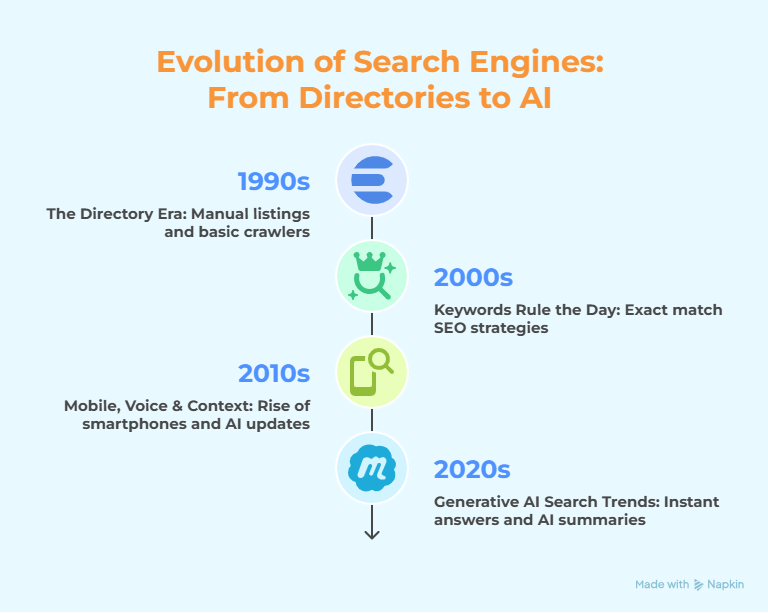
1990s: The Directory Era
Before Google arrived, search engines like AltaVista and Yahoo! worked more like directories. Pages were listed manually or indexed through basic crawlers. There was little focus on user intent. Relevance was based on simple keyword matching and page titles.
2000s: Keywords Rule the Day
This was the age of “exact match.” If users typed “best CRM software,” your content had to include that exact phrase to rank. SEO success meant stuffing the right keywords in the right places – titles, meta tags, and backlinks.
Content was written for algorithms, not people. Search engines weren’t smart enough to understand intent, so matching exact phrases was the game.
2010s: Mobile, Voice & Smarter Search
The rise of smartphones changed everything. Suddenly, search was happening on the go. At the same time, tools like Siri and Google Voice led to more natural, conversational queries.
Google’s Hummingbird and RankBrain updates helped search engines understand meaning, not just match words. Instead of typing “email tools,” users might ask, “What’s the best email marketing platform for beginners?”
Context, location, and phrasing started to matter more than exact keywords.
2020s: Generative AI Search Trends
Nowadays, search isn’t just about finding links anymore. It’s about getting instant answers. Tools like ChatGPT, Perplexity, and Google AI Overviews now generate full responses to complex questions, often without showing traditional search results.
Instead of scanning 10 blue links, users get a direct, AI-written summary. That’s a massive shift in how people find and trust information.
Backed by Microsoft’s $10 billion investment in OpenAI and Google’s push behind Gemini and AI Overviews, AI is no longer a future trend. It’s the new standard for search.
AI answers have started to replace the traditional search results provided by search engines like Google. If your business isn’t visible in AI answers, soon it will not be visible at all!
Why This Shift Matters for Business Owners
- Five years ago, someone might have Googled “marketing automation” and scanned a list of websites shown in the search engine result pages to find the information they needed.
- Today, they’ll ask a chatbot, “What marketing automation tools fit a 50-person agency focused on lead nurturing?”
That conversational style needs detailed, intent‑based content, not just some keyword-optimized pages.
What to Do Today
- Map your content to user intent: Build blog posts or tool pages around real questions (long-tail prompts).
- Use tools like ChatGPT or Perplexity: Test how they answer your sector questions. Are you mentioned?
- Invest in structured content: Use FAQs, quick stats, and clear headings to make AI generation easier.
Now that you know how search has evolved, you can appreciate why “search prompts” now matter more than specific keywords. Next, we’ll dive into the benefits and challenges of generative engine optimization and why it’s critical for businesses today.
Benefits and Challenges of GEO for Businesses
Switching to Generative Engine Optimization (GEO) can feel like a big leap, especially if your business is still working to master traditional SEO. But understanding the GEO benefits alongside the generative search challenges helps you plan smarter and stay ahead.
Why GEO Is a Big Opportunity
GEO isn’t just a new trend – it’s where search visibility is heading. Here’s what it brings to the table:
- Better alignment with how people search now
More users ask conversational, real-life questions nowadays. This is something traditional SEO often misses. - Early-mover advantage
While many businesses are still figuring this out, optimizing your website for generative engines now puts you ahead of the curve. - Increased brand authority
Being cited by AI tools like ChatGPT or Google AI Overviews builds instant trust. If AI selects your content, people assume it’s reliable. - More targeted leads
GEO helps you show up in AI answers to highly specific queries, attracting visitors who are further along in the buying process. - Long-term relevance
As AI search grows, businesses that invest early in generative engine optimization will stay visible, even if traditional clicks decline.
But It’s Not Without Challenges
Like any shift, you may face some real hurdles while adopting GEO:
- Lack of clear metrics
Unlike traditional SEO, there’s no universal “ranking” system for generative engines. You’ll need to track visibility using tools like AlsoAsked, SparkToro, or even manual testing in ChatGPT or Perplexity. - Content demands are higher
AI looks for structured, detailed, and well-supported content. Shallow posts won’t make the cut. - Technical uncertainty
Google’s AI Overviews and OpenAI’s browsing behavior are still evolving. You’ll need to stay flexible as platforms change. - Harder to “game” the system
Traditional tricks like keyword stuffing or backlink farming don’t work here. Generative Engine Optimization rewards quality over quick wins.
Tip
Focus on building useful, structured content that answers real questions in your niche. That’s your safest bet as AI search keeps growing.
Benefits and Challenges of GEO for Businesses
If you’ve ever asked ChatGPT for a tool recommendation and taken it at face value, you already understand the power of generative answers. GEO helps your business be part of those AI-driven suggestions, but getting there takes strategy.
Why GEO Is Worth It
Done right, Generative Engine Optimization (GEO) can expand your reach even as traditional SEO gets more competitive. Here’s what businesses are already gaining from it:
- More visibility, even without clicks
AI search often gives users direct answers, cutting out the click-through step. GEO helps your brand get cited in those summaries, which builds trust instantly. - Stronger leads from higher-intent queries
People don’t ask AI vague questions. They ask specific, real-world ones like “What’s a good CRM for a 50-person agency doing email nurturing?” That means when you show up, you’re more likely to get serious buyers. - Positioning as a trusted source
If AI tools consistently mention your brand, readers start to see you as a go-to name in your field, even if they never visit your site directly.
The Flip Side: Common Challenges
Of course, GEO isn’t plug-and-play. Here’s what might hold you back, and how to move forward anyway:
- “We don’t have enough content.”
You probably do. Start by repurposing old blog posts into FAQ sections or detailed explainers tailored to real questions your customers ask. - “How do we know if it’s working?”
Unlike traditional SEO, you won’t always see traffic spikes. Instead, look for signs like increased brand mentions in AI tools or more leads saying, “I found you through ChatGPT.” - “We’re not technical enough.”
You don’t need to be. Tools like Perplexity or even Google’s AI Overview are great for testing what kinds of answers show up and where your content stands.
What We’ve Seen Firsthand
When I first started helping clients with generative engine optimization, we didn’t overhaul entire websites. We took high-performing content, rewrote sections to answer long-form questions, and added clearer structure. Within a few months, their brand started appearing in AI answers, even for some queries they didn’t even rank for in Google.
Essential Concepts Every Beginner Should Know
Before diving into generative engine optimization, you need a solid grasp of foundational concepts that help AI models recognize your content as trustworthy. Here’s what really matters.
1. Experience, Expertise, Authoritativeness, Trustworthiness (E‑E‑A‑T)
- Experience: Show real-life insight. A line like “I’ve used Salesforce for five years with similar agencies” tells AI and readers you’ve been there firsthand.
- Expertise: Cite credentials or case studies. If you’ve helped multiple clients scale marketing ops, say so clearly.
- Authoritativeness: Earn backlinks from reputable sources, guest post on trusted industry blogs, or get mentions in listicles.
- Trustworthiness: Be transparent. Use author bios, proper citations, and contact details for credibility. Google uses these signals to judge content quality even for AI-powered search.
Together, these factors help AI systems see your content as reliable, which is a key factor for getting cited in AI answers.
2. Conversational Search & Query Intent
People now ask detailed, conversational questions, not keywords.
- Old query: “CRM software”
- Modern conversational query: “What’s the best CRM for a growing SaaS company with remote teams?”
Tip
Check “People Also Ask” in Google or try a question in ChatGPT/Perplexity. Use the resulting prompts to guide content framing.
3. Structure for AI Readability
AI engines favor content that’s easy to parse:
- Use clear headings and bullet sets
- Keep sections concise. 150-200 words is ideal to increase chances of AI citations in overviews
- Answer each key query explicitly and clearly
Tip
Write a short FAQ section for each long article, focusing on real questions your audience asks.
4. Optimum Content Length Still Matters
There’s no magic word count, but content should be as long as it needs to be to fully answer a question. Brief answers may work for AI overviews, but detail adds authority and keeps readers engaged.
5. Topic Authority through a Pyramid Approach
Build depth in your niche by:
- Publishing comprehensive pillar posts
- Adding follow-up Q&A or how-to articles branching from that pillar
- Linking them together so AI and readers see a coherent resource hub
This layered model boosts topical authority, making it easier for AI to cite your content.
With these foundational pieces (E‑E‑A‑T signals, conversational queries, clean structure, smart length, and topic depth), you’ll have the blueprint to write content AI can confidently use.
Tools and Resources Needed to Get Started with GEO
Getting started with Generative Engine Optimization (GEO) doesn’t require a big budget or an SEO agency. You just need the right mix of free and affordable tools that support conversational search, content clarity, and AI testing.
a. $0 Starter Pack
- Google’s “People Also Ask”
Instantly shows real questions people are typing into search. Great for content ideas. - AnswerThePublic
Visual tool for uncovering conversational queries. Perfect for brainstorming long-form topics. - ChatGPT (Free version)
Use it to test how AI might answer customer questions and see what content it pulls from.
B. $100/Month Growth Pack
- AlsoAsked (~$15/month)
Builds question trees that help you create deeper content clusters. - Keywords Everywhere (~$10/month)
Adds search volume and intent data right into your browser as you research. - SurferSEO (~$89/month)
Helps structure your content for AI-readability and keyword coverage.
Tip
For growing teams, advanced tools like MarketMuse or Semrush offer added insights. But these are not required to start seeing results with GEO.
Don’t wait to “have the perfect stack.” Start with what’s free and available. You can build your GEO toolbox over time—but the key is taking that first step toward aligning your content with how people (and AI) are searching today.
How to Use These Tools Together in a Simple Workflow
- Find real user questions
Use Google or AnswerThePublic to gather common queries about your product or niche. - Test how AI answers them
Run those same questions through ChatGPT or Perplexity. Pay attention to tone, structure, and which sources are referenced. - Create structured content
Draft clear, skimmable content using SurferSEO or Google Docs. Prioritize clarity, proper headings, and concise answers. - Check how you’re showing up
Revisit those queries every few weeks in AI tools. Are you being mentioned? Are the answers shifting? Use that feedback to refine your content.
Even with just the free tools, this simple routine gets you moving in the right direction: towards visibility in AI-powered search.
Tip:
Don’t wait to “have the perfect stack.” Start with what’s free and available.
You can build your GEO toolbox over time, but the key is taking that first step toward aligning your content with how people (and AI) are searching today.
Beginner’s Step‑by‑Step Guide to Implementing GEO
If you’re new to Generative Engine Optimization (GEO), here’s a clear, realistic roadmap you can follow to start seeing results, even if you don’t have a technical background.
Each step is designed to help you build content that AI tools can understand, trust, and reference.
Step 1: Identify Your Audience and Their Needs
Before writing anything, be clear on who you’re creating content for. Think about:
- What type of business they’re in.
- What job titles do they hold?
- What problems are they trying to solve?
- How do they typically phrase those problems in a search?
Use tools like Google’s People Also Ask or AnswerThePublic to uncover real questions. These become the foundation for your content.
Deliverable: A list of 10–20 actual long-form questions that the users are asking that your content can answer. The questions need to be relevant to your niche.
Step 2: Conduct Generative Keyword Research
Unlike traditional SEO, generative engine optimization focuses on full questions and problem-based queries. Hence, instead of targeting short keywords, think in full questions and prompts.
Tools like AlsoAsked and Keywords Everywhere can help you see the questions people ask before and after your main topic.
Build a simple spreadsheet where you track:
- Question
- Intent (informational, transactional, etc.)
- Which AI platforms already answer it, and how
Pro Tip:
Target questions where your product, service, or expertise clearly fits the answer.
Step 3: Create High-Quality, Authoritative Content
Now, create content that directly and clearly answers those questions from Step 2. Prioritize helpful, trustworthy, and easy-to-skim content.
- Headings for each subtopic or question
- Bullet points or numbered lists
- Include personal insights, first-hand examples, mini case studies, or experience-based insights
- Add Author bios or contributor info to build trust and credibility
Tip
Avoid the common mistake of writing for search engines instead of people. GEO rewards clarity, not keyword density. Hence, GEO content should be clear, natural, and useful.
Step 4: Optimize for Generative Engines
Once your content is live, test how it performs on platforms like ChatGPT, Perplexity, or Google’s AI Overviews.
Paste the target question into these tools:
- Does your brand or content get cited?
- If not, what type of content is being referenced instead?
Use that feedback to adjust your structure, tone, and phrasing.
- Add clearer structure (like lists or definitions).
- Use more natural, question-based phrasing.
- Strengthen your authority signals (e.g., citations, bios).
Step 5: Apply Technical Best Practices
Even the best content can be overlooked without good technical hygiene. Ensure:
- Make sure that the pages load fast and are mobile-friendly.
- The pages are crawlable and indexable.
- Add FAQ schema or article markup to help machines read your content better.
- Use internal linking to build topic clusters. This shows depth.
You don’t need to over-optimize. Just make it easy for both humans and machines to navigate.
Step 6: Monitor and Improve Over Time
Generative Engine Optimization isn’t a “set it and forget it” strategy. Revisit your content every few months to check:
- Is your content appearing or getting cited in AI answers?
- Are branded search queries or citations increasing over time?
- Are the leads you are getting mentioning that they found you through AI searches/answers?
Update posts based on how AI engines are evolving. Sometimes, just rewriting a paragraph or adding a list makes all the difference.
Remember that small updates can lead to big gains, especially as AI tools evolve their sources.
Quick Recap: GEO in 6 Steps
| Step | What to Do | What You’ll Achieve |
|---|---|---|
| Step 1 | Find out what your audience really wants to know | Clear direction for content that meets actual user needs |
| Step 2 | Build a list of questions with real search potential | A focused set of prompts your content should target |
| Step 3 | Write content that answers those questions with clarity and credibility | AI-friendly content that builds trust and authority |
| Step 4 | Test how AI tools interpret and reference your content | Insights into how your content performs in generative search |
| Step 5 | Fix any technical gaps in structure, speed, schema | Better readability and crawlability for both AI and users |
| Step 6 | Track performance and adjust regularly | Ongoing improvement and growing visibility in AI search |
This process is repeatable. Start with one topic, refine your approach, and scale as you go.
Integrating GEO with Existing SEO Strategies
If you’re already investing in SEO, the good news is you don’t have to start over. Generative Engine Optimization (GEO) builds on the foundation you’ve created. It just shifts how your content is found and cited.
Here’s how to bring GEO into your strategy without losing the SEO gains you’ve worked hard to build.
Start by Adjusting Focus, Not Abandoning SEO
Traditional SEO still matters. Your site needs to rank, load fast, and be optimized for search engines. But to appear in AI-generated answers, you also need content that AI tools can parse, summarize, and trust.
Tip
Think of it as content expansion, not replacement.
Use the 70/30 Rule to Start
For beginners, a smart approach is to allocate:
- 70% of your effort to traditional SEO (technical fixes, link-building, keyword rankings)
- 30% to GEO (question-based content, structure, authority signals)
Over time, you can adjust this ratio based on what’s driving real results.
Repurpose What You Already Have
You don’t need to create everything from scratch. Take existing blog posts and:
- Add a short FAQ section at the end with real user questions
- Break long paragraphs into clear bullet points and headings
- Include sources, case studies, or quotes to build trust
Example: Turn a post titled “Top Email Tools for 2025” into a Generative Engine Optimization-ready piece by answering:
“What’s the best email tool for a remote B2B team focused on lead nurturing?”
Gradual Integration Timeline
Month 1: Identify high-traffic or evergreen posts that can be updated for GEO
Month 2: Update structure, add FAQs, and test content in ChatGPT or Perplexity
Month 3: Create 2–3 new question-driven posts based on your GEO research
Avoid These Common Mistakes
- Don’t skip keyword research: You still need to understand what people search, even if they phrase it differently for AI.
- Don’t treat generative engine optimization as a trend: AI-powered search is growing quickly. It’s not a short-term experiment.
Assign GEO Without Overloading Your Team
If you already have an SEO writer or strategist:
- Assign GEO tasks like prompt testing, content restructuring, or FAQ writing
- Encourage collaboration between SEO and content teams to align keyword targets with AI-friendly formats
Bottom line: You don’t need to choose between SEO and GEO. Done right, they support each other, keeping your content visible across both search engines and AI-generated results.
GEO Best Practices for the Most Popular AI Engines
This section gives you tailored guidance for ensuring your content performs well across different AI search platforms. Whether it’s Google’s AI Overviews, ChatGPT, or Perplexity, each one has a slightly different style and objective. Here’s how to optimize for all three.
Google AI Overviews Optimization
Google’s AI Overviews (formerly known as Search Generative Experience, or SGE) appear at the top of search results, summarizing content from multiple sources. To boost your odds of inclusion:
- Use question-based headings (H2/H3) that match conversational queries.
- Write an immediate, clear answer in the first 1–2 lines, then expand below.
- Stick to structured content: bullet lists, FAQs, and data points.
- Maintain strong E‑E‑A‑T signals by adding author bios, internal links, case studies, and practical examples.
- Use FAQ or Article schema markup to help Google parse your answers easily.
ChatGPT SEO (Optimizing for ChatGPT and Similar AI Tools)
ChatGPT and similar AI agents favor clear, authoritative information when answering user questions. To improve visibility:
- Avoid buried content. Ensure that the key points are in the visible page text, not hidden in images or scripts.
- Include experience-based language like “I’ve used this tool for 5 years…” to boost trust.
- Understand that AI picks up content from sources it considers high authority, so strong backlinks and mentions still matter.
- Regularly run your target questions in ChatGPT or Perplexity to see how your content is referenced, and adjust for tone or clarity.
Perplexity, Claude & Other AI-Powered Engines
Platforms like Perplexity and Claude use AI to answer questions and sometimes cite sources. To optimize:
- Use clean bullet and number formats for easy ingestion.
- Build short content blocks (100–150 words) focused on single questions or definitions.
- Structure mini FAQs or Q&A tables within longer articles to increase the likelihood of being excerpted.
A Comparison Of The AI Platforms
| Platform | Format Focus | Why It Matters |
|---|---|---|
| Google AI Overviews | Question headings and structured text | Helps Google generate answers from trusted content |
| ChatGPT / Claude | Experience‑rich, clear inline content | Enables direct mention and citation by AI agents |
| Perplexity | Short, focused sections and FAQs | Makes your answers easy to extract and reference |
Testing and Updating Tips
- Track how frequently your content is mentioned across platforms. Run your prompts every few weeks.
- Update your content based on changing AI response styles: change wording, add new bullet points, or expand sections.
- Stick to a consistent update rhythm, such as every 3–6 months, to keep pace with evolving engine behavior.
Our Test Results
After testing over 100 queries across ChatGPT, Google AI Overviews, and Perplexity, we have observed this pattern:
- Content with clear definitions and data points at the top shows up more often in Google AI summaries.
- ChatGPT tends to cite authoritative content with real examples and credentials.
- Perplexity favors short, structured snippets that match user prompts precisely.
By applying these platform-specific tactics, your content will be ready for AI engine optimization. Once you’ve implemented these best practices, you’ll be better positioned to show up in AI-generated answers – while continuing to support your traditional SEO efforts.
Measuring Success in Generative Engine Optimization
Tracking GEO performance is a bit different from traditional SEO. Since AI tools often summarize content without sending users to your site, success isn’t always about traffic – it’s about visibility and influence.
That said, you can measure impact with the right approach.
Key GEO Metrics to Track
While dedicated analytics tools for generative engine optimization aren’t mainstream yet, there are still ways to monitor performance:
- Branded search volume: More people searching your name? It’s a sign they likely saw it in an AI answer.
- Manual citation checks: Paste your target queries into ChatGPT, Google’s AI Overviews, or Perplexity and track if your content is referenced.
- Referral traffic in GA4:
- Go to User Acquisition > Source/Medium
- Look for referrals like
"chat.openai.com"or links with?utm_source=chatgpt.com - This helps identify AI-driven visitors.
- Content engagement: Use GA4 to track scroll depth, time on page, and click-throughs, especially on FAQ or GEO-focused content.
Tip
Add UTM parameters to your links so you can trace where AI referrals are coming from, even when click data is limited.
New Tools Are Catching Up
- ChatGPT now appends
?utm_source=chatgpt.comto links it cites, making tracking easier. - Ahrefs and SEMrush have begun showing AI citation data in their dashboards.
- We expect more SEO tools to follow with AI-focused reporting features in the months ahead.
Monthly GEO KPI Snapshot
| What to Track | Where to Look |
|---|---|
| Branded search growth | Google Search Console |
| ChatGPT or Perplexity mentions | Manual prompt testing |
| Referral traffic from AI | GA4 (User Acquisition) |
| Page-level engagement | GA4 (Engagement Reports) |
| Inbound AI-driven leads | CRM or form tracking (with UTMs) |
ROI Example
Let’s say you spend $500/month on generative engine optimization-related content and tools. If that leads to just one new $2,000 customer per month from AI-influenced discovery, you’re already getting a strong return, with enough room to grow.
A Final Word on tracking
There’s no all-in-one generative engine optimization dashboard yet, but eventually that’s going to change. For now, combine manual checks with smart use of GA4 and link tagging. What matters most is whether your content is influencing decisions, even if it’s behind the scenes.
The Future of GEO: Trends to Watch
AI search is changing quickly, and that makes many marketers wonder, “Will everything I’m doing still matter in a year?” The answer is yes, but only if you stay flexible.
Here’s what to expect in the near future and how to keep your GEO strategy ready.
What’s Coming Next in AI Search
1. Search is becoming more conversational
People are using tools like ChatGPT and Google’s AI Overviews to ask complex, follow-up questions in natural language, not just keywords.
2. Visual and voice search are growing
Platforms are beginning to include images, videos, and voice prompts in their answers. Microsoft’s Copilot and Google’s AI Mode already support these formats.
3. AI-generated summaries are replacing links
In many cases, AI tools are currently summarizing answers without showing full search results. Hence, your content needs to be structured clearly enough to be pulled into those summaries.
How to Future‑Proof Your Generative Engine Optimization Efforts
The following steps will help your content stay visible even as AI tools evolve:
- Keep content modular: Break long articles into clear sections or FAQs.
- Use natural language: Write the way your audience talks and searches.
- Add visuals: Support your content with helpful images, charts, or short videos.
- Update regularly: Refresh content every few months to match new search formats.
- Test your content: Use tools like ChatGPT or Perplexity to see how your pages appear in AI responses.
Tip
If you’re creating something new, always ask, “Will this be easy for an AI tool to summarize and trust?”
You don’t need to chase every new trend. But by making small adjustments now (e.g., clearer structure, more context, and conversational tone), you are setting up your content for long-term visibility in AI-driven search.
Build Smart, Stay Visible, Grow Confidently
Generative Engine Optimization isn’t just a trend. It’s a shift in how people find and trust information. By aligning your content with how AI engines deliver answers, you’re setting your brand up for lasting visibility and credibility.
Yes, it takes work. There will be moments where progress feels slow or uncertain. That’s normal. The key is to start simple, like turning one blog post into a clear Q&A format, and build from there.
The effort you invest in GEO now will pay dividends in sustained organic visibility and brand authority.
You’ve got this, and your audience will benefit from the foundation you’re building.
If you want to know about other marketing strategies, then read our article on 5 Essential Digital Marketing Strategies to Level Up Your Business.
If you need help in refining your broader strategy, then contact us for a free, one-to-one consultation.
Frequently Asked Questions
What is the difference between SEO and GEO?
Generative Engine Optimization (GEO) focuses on getting your content cited by AI tools, while traditional SEO aims to rank in search engine results. The key difference is that GEO targets AI-generated answers, not just search engine listings. For example, SEO helps you rank for “best CRM software,” while GEO positions you to be referenced when someone asks, “What CRM should a remote B2B team use for lead nurturing?”
Is GEO replacing traditional SEO completely?
No, GEO is not replacing traditional SEO. It complements it. While SEO helps your site rank in search engines, GEO ensures your content is structured and trusted enough for AI tools to cite in responses. You don’t need to abandon SEO; instead, integrate GEO by adding question-based formats, strong authority signals, and updated structure. The shift is gradual, but preparation matters now.
How do I start implementing GEO for my business?
Start GEO implementation by identifying real questions your audience asks online. Then, follow a simple 3-step process: 1) Use tools like AnswerThePublic to find queries; 2) Create clear, structured content that answers them; 3) Test your content in ChatGPT or Perplexity to see if it appears in results. You can begin seeing impact in as little as 4–6 weeks.
What tools help measure GEO performance?
To measure GEO performance, use Google Search Console for branded search trends, Google Analytics 4 (GA4) for referral traffic and engagement, and manual testing with ChatGPT or Perplexity. GA4 tracks AI traffic under “referral” in User Acquisition, and ChatGPT now adds “?utm_source=chatgpt.com” to cited links. Most tools are free, with premium options like Ahrefs starting to include AI citation data.
How long does it take to see GEO results?
You can expect to see early GEO results in 6 to 12 weeks, depending on how competitive your niche is and how well your content is structured. Faster results come from repurposing existing content into Q&A or FAQ formats. Early signs of success include increased branded searches, AI mentions, and better engagement on optimized pages.




Leave a Reply